On the Colour Couch with Greg Penn, AKA @manwithahammer
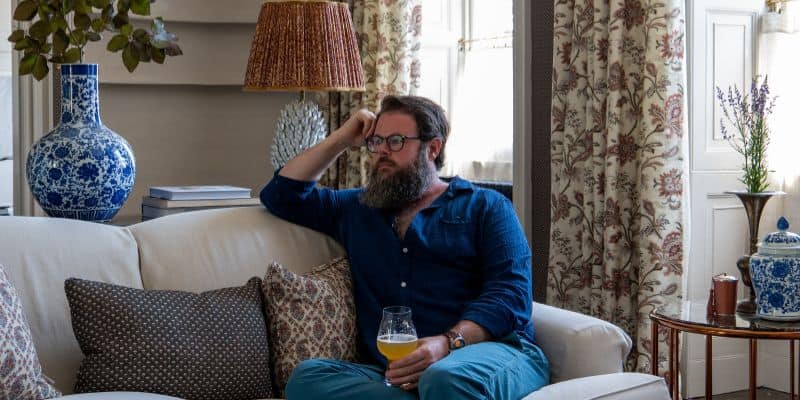
Welcome to On the Colour Couch! I’m thrilled to share this special feature because it’s the first time I’ve conducted an interview with a video element to accompany it. I thought this format would add something extra, and I couldn’t think of a better guest for this milestone than Greg Penn.
Greg is someone I’ve admired for years for his dedication and passion in restoring an extraordinary historic home – Admirals House. You may know him as @manwithahammer on Instagram, where he documents his progress with incredible detail and enthusiasm.
I first invited Greg to join me for an interview over a year ago, but at the time, he was deeply immersed in writing his book. Now that it’s complete, we finally had the chance to sit down and chat.
In this article (which you’ll find below the video), I’ve kept to the Colour Couch interview questions along with some bonus questions. If you’d like to explore more, the video dives into the history of Admiral’s House, Greg’s restoration journey, and some entertaining tangents—including our shared experiences with book writing. Enjoy…!

Read The Colour Couch Interview
If you’ve seen Greg’s colour-filled home on Instagram, you might be as surprised as I was to learn something he shared in one of his posts. Greg has colour deficiency (what used to be called colour blindness). Naturally, that was the first question I just had to ask him.
Given the amount of colour in your home, how do you work with colour having colour deficiency? How do you how do you do this?
I get asked about my colour blindness quite a lot, especially when I talk about it on Instagram, because it’s something that affects a lot of men—it’s actually very common. I wanted to show that people with colour blindness can absolutely have colourful homes. People often ask how I manage it, but the truth is, I’ve only ever seen through my eyes, so I have no idea how someone without colour blindness sees.
For me, it’s about shades, greens, reds, or other colours I work with. For example, if there’s a rose bush with lots of green foliage and small red roses, I might not see the roses at all. But if you hand me a single red rose with its green leaves, I’ll see both colours clearly. It’s when they’re together that my brain has trouble processing them.
Even in everyday situations, like when my partner, Katalin, wears a dress, I might think it’s green or brown, but she’ll tell me it’s actually red. It’s not that I can’t see colour – some people assume colour blindness means you see in black and white, which isn’t true. I see colours, but my perception of certain combinations is different, especially when they’re side by side.
I haven’t done much research into it because it’s all I’ve ever known, and it hasn’t really affected me. As a kid, I was told I couldn’t be a pilot, an electrician, or join certain jobs in the army, but beyond that, it’s never been a big issue. I’ve found ways to manage, like sharing my work on Instagram. It’s a bit of a safety net because I can see that what I’ve chosen works, and others seem to think so too.
I think it’s important to share this because I want people to know it shouldn’t stop them from having a go. My colour blindness hasn’t stopped me from creating a home I love.
Then Greg goes on to share his experience of what it’s really like to learn and name colours with colour deficiency…
People sometimes ask, ‘What colour is the sky then?’ And I’ll say, ‘It’s blue.’ But I only know that because I’ve been told it’s blue. When we’re kids, we’re taught colour names through references, so I associate the sky with blue because that’s what I’ve been told – it’s not some innate knowledge.
Honestly, I try not to overthink it. I don’t want my colour blindness to influence my design decisions too much. For me, it’s simple: I design based on what I like, and now that my partner lives here too, what she likes. That’s it. I don’t want to complicate it with questions of what’s ‘normal.’
You can get special glasses that show what normal colour perception looks like, but I’m a bit scared to try them. I think it would be confusing. What if it makes me second-guess everything? When I take them off, I’d still be back to my usual self, and I don’t want to design with two different mindsets. For now, I’m happy winging it and keeping things straightforward.
What is your earliest colour memory?
I don’t think I really thought about colour much until I took a colour blindness test when I was about 8 or 9.
I might be quite different from a lot of your guests. For starters, I’m a chap, and while colour doesn’t have a gender, in my earlier life, I thought about it far less than the average girl growing up. Girls often have more interesting clothes, whereas I wasn’t remotely interested in clothes – still aren’t, to be honest. I never thought about what colour I might dye my hair or how I’d accessorise with a handbag or shoes. It didn’t even cross my mind.
I never supported a football or sports team, so I didn’t have a colour I associated myself with. I liked colours, but I never had a strong attachment to any one in particular.
The first time I really had to think about colour was during that test, when I was told I was colour blind. Until then, it wasn’t something I gave any conscious thought to.
Growing up, my experiences with colour were probably quite different from many of your other guests, who were likely much more interested in it from an early age.
It wasn’t until I bought my first house and started thinking about what colour to put on the walls that I gave it any real consideration. I suppose you could say I came to it quite late in the game.
What does colour mean to you now?
I think colour just means life, home, and fun to me. The thing is, I really appreciate all sorts of architecture and interiors. I can admire super modern, minimalist spaces and buildings with almost no colour, they’re incredibly beautiful. But I wouldn’t want to live in them.
For me, it’s not about thinking they aren’t stunning; they absolutely are. But I’m a bit scruffy, big, gregarious, and over the top. Whenever I’m in a super neat, minimalist space, like sitting on a crisp black leather sofa against white walls, I feel like I’m making the place look messy. It doesn’t make me feel welcome or comforted because of who I am.
Colour, to me, takes away some of that stiffness. It makes a space feel warm, comforting, and relaxing. Sure, I’ve had comments from people saying my house looks overstimulating and that they wouldn’t find it relaxing at all. And that’s okay – design is personal.
For me, I’ve always wanted my house to feel like a home, not a museum. Admiral’s House has all this grandeur in its architecture, but I want people to walk in and feel like they can kick off their shoes, put their feet on the sofa, and just relax. Colour and pattern really help to convey that feeling.
Without overthinking it, it’s about how a space makes me feel. Does it make me want to relax and feel comfortable, or does it make me sit up tight and be on my best behaviour? There’s a time and place for both, but my home is meant to be a place where people can feel relaxed, enjoy themselves, and just be whoever they want to be. That was always my intention.
Do you have a favourite colour now? Is there a colour that you feel you gravitate more towards?
I was thinking about this, and in almost all the rooms, blue is used in some form. It could be a lot of blue, or just a little, like in an accent. I feel very comfortable with it. I don’t know if it’s because of my perception of it. Blue isn’t on the red/green spectrum at all, so maybe that makes it easier for me. Whether it’s because I feel more confident with it or just because I like it, I haven’t really thought much about why I use it more.
It’s not that I look at blue and think, ‘Oh, that’s nicer than green.’ It’s more that I feel familiar and comfortable with it. I also think it goes well with lots of things. To me, you can pair blue with so many other colours, and it works. In the bedroom I just finished, I’ve used blue with yellow. In a bathroom upstairs, I’ve paired blue with pops of red and coral. It’s a colour that feels very friendly and versatile in interiors for some reason.
On the other hand, I really like the colour green. I love nature, trees, and watching the leaves change to autumnal colours. But I find green more challenging to decorate with. I can only assume it’s because my perception of green is weaker, so I feel less confident using it in interior schemes.
That doesn’t mean I like green any less or that I’d avoid wearing it, but when it comes to interiors, I feel less sure of it compared to blue. For me, blue just feels easier and more intuitive to work with.
Greg shares his approach to his evolving interior design process
I work differently from an interior designer. I take forever to make decisions. Because I do everything myself, from stripping the room out to preparing it, the rooms take six months to finish because they’re so knackered and old.
I get to spend a lot of time in those spaces and make decisions slowly, in real time. For example, I’ve only just decided on the curtains for a room I finished painting and decorating two or three months ago. Living with it for a bit helps me decide what works.
I’m not talented enough as an interior designer to look at little swatches of stuff and say, ‘That’s all going to look great as a scheme.’ So I take my time, and the spaces evolve in a really nice, organic way. I’m also really lucky because I get to see each room in all the different seasons, in all the different weathers, and in all the different light conditions. That massively changes the feel of a space and absolutely impacts the colours and the scheme I choose for the room. I just can’t do a whole room in one go.
For anyone afraid of colour what would your number 1 piece of advice be?
I would say, live with the colour for a while. Paint some big samples and stick them on different walls to see how it looks in different parts of the room. Pay attention to how the light changes throughout the day and how it makes you feel. Also, think about the practical side such as considering which direction the room faces and the quality of light. For example, a cool blue might suit a north-facing room if that’s the look you’re after, but if you want something warm and inviting, it may not be the best choice.
Kate Watson-Smyth from Mad About the House who has also been featured On The Colour Couch, was a huge inspiration when I started renovating my first house. Her blog made interior design and colour feel accessible and practical, which was a big help for someone like me, coming from a non-design background. That approach gave me the confidence to experiment and trust my instincts.
If you’re nervous, start with one thing. Maybe a main colour or wallpaper and let that guide the rest. Take your time, live with your choice, and build from there. There’s no need to decide everything all at once.
And yes, rolling on that first coat of paint can be terrifying. It’s that ‘What have I done?’ moment, but trust the process. Even if the first coat looks rough, stick with it. While people say, ‘It’s just paint, you can repaint it,’ that’s not always as easy as it sounds, especially if you’ve seen what badly applied paint can do. So take your time, make considered decisions, and enjoy bringing your vision to life.
Why painting feels like a reward for Greg
When I shared with Greg that, when it came to painting my living room, I knew it was absolutely the right colour but that I didn’t enjoy prepping and setting everything up. I just didn’t enjoy that process – his response was really interesting…
For me, painting is the cherry on the cake. The sanding and stripping, that’s 95% of the work. When it finally comes to painting, it feels like a holiday. I love it – it’s my favourite bit. Everything else makes the room look worse, but as soon as you get the paintbrush out, you know it’s going to start looking better, which is really exciting.
Which colourful person do you most admire and would love me to interview for the On the Colour Couch series?
I recently got to spend a day with Nicola Harding on her ‘Homing Instinct’ course held in her London Studio. For those not familiar with Nicola, she’s an incredible interior designer whose work I’ve admired for years and she has a wonderful way with colour in her work, and getting to spend a day with her helped a lot with my understanding of how she uses and plays with it, and also helping me to organise my thoughts on it a bit too, taking it from being something I thought was a gut instinct, but actually there was a bit more thought process going on than I might have first realised. She might not be up for an interview – it would perhaps be too much like her giving away her trade secrets haha, but certainly I would encourage your readers to have a look at her work, it’s beautiful!
Greg’s approach to colour is refreshingly personal and practical, proving that you don’t need perfect vision or a perfect plan to create a home that feels vibrant and inviting. His advice to take your time, experiment, and trust your instincts is a reassuring reminder that colour is about creating a space that feels like you. Whether you’re picking a bold wallpaper or simply testing samples on your walls, Greg’s journey shows that embracing the process is where the magic happens. So don’t be afraid. Dive in and let colour bring your home to life!
If you would like to discover more about Greg and Admiral House he is renovating, head over to her Instagram @manwithahammer.
Wishing you a colourful day,
Karenx
You can read Kate Watson-Smyth, also known as Mad About The House, in her On The Colour Couch interview over here.
And you can find Nicola Harding on Instagram here.
SIGN UP FOR MY NEWSLETTER
Get a Free Chapter from The Little Book of Colour
© Karen Haller
Designed by cptcreative.com