On the Colour Couch with colour historian Patrick Baty

If you love colour history you may already know the name Patrick Baty.
Together with his family he runs Papers and Paints in Chelsea, London, a specialist paint shop that is a go to for designers and heritage experts searching for authentic historic colours.
Patrick is renowned for uncovering the stories hidden in old layers of paint and for bringing those findings to life in his books The Anatomy of Colour and Nature’s Palette.
He travels widely, advising on restoration projects and showing how colour connects us to our architectural past.
Along with the usual questions I ask all my guests, I was curious to learn more about the behind the scenes work that Patrick does. So let’s dive in…
What is the most remarkable or memorable house you have worked on, and what did its paint history reveal about the people who lived there?
I am lucky enough to have worked on many memorable, even remarkable houses. However, a recent project brought me close to two notable individuals who had actually mixed the colours that I was looking for. This was at Kelmscott Manor, in Oxfordshire, the country home of the writer, designer and socialist William Morris. From 1871, for the first three years of the lease, it was shared with his friend Dante Gabriel Rossetti.
My task was to establish the colours that had been applied by them in the White Room and on the overmantel of the Old Hall. From an examination of the layers of paint, I was able to date the panelling in the White Room to ca.1750-60 and established that it was the off-white 13th scheme that had been applied by Morris / Rossetti.
The olive green of the first scheme on the overmantel was found to date from the early 1870s and was also their work. In the Green Room, I was able to date the first dark Brunswick green scheme to 1883. The appropriate colours were mixed by us at Papers and Paints and have been applied in the various rooms.
When you are investigating a historic building, how do you determine which layer of paint best represents its most significant period of use?
Before starting an analysis, it is important to establish the aim of the exercise. Often, such as at Kelmscott Manor, it will be a scheme that is associated with an historical event or a well-known figure. At Stowe, for example, the target date has been ca.1800, when the family and house are considered to have been at their peak.
In a more domestic context, I will report on the sequence of decorative schemes employed in the past and will often suggest what might be the most appropriate or the one that fits in best with the client’s taste.
What is the most challenging pigment or colour to authentically recreate from the 18th or 19th century, and why?
Perhaps the most difficult pigment to imitate is Smalt, the ground blue pigment made of potassium glass whose colour comes from a small amount of cobalt oxide added during its preparation.
One method of obtaining the best colour was to scatter the tiny shards on a coat of a pale blue oil paint that had been allowed to stand for a short while after application. As a result, the particles adhered to the still-sticky surface and remained embedded in the paint film. These particles were quite large and tended to catch the light. Admittedly, the effect was best when seen at a distance.
The colour was notoriously fugitive, and it tended to be discoloured by moisture. I have found it on a number of items of late 17th and early 18th century Royal ironwork. Under the microscope it is only the larger fragments of glass that have retained the blue colour, the smaller particles look like clear untinted glass. One has to be aware of the possibility of its use, otherwise it might be unrecognised.
When the Queen’s House, at Greenwich, was redecorated following my colour plan, we tried dusting smalt onto the famous Tulip Staircase. However, it was a laborious and not altogether successful experiment that was deemed impracticable and very expensive. Not only that, but it would not have lasted long. As a result, I matched the colour in a conventional paint and that was applied instead.
Have you found instances where the original colour choice completely surprised you compared to our modern expectations of that era?
I have learnt not to pre-judge and often come across surprises. There was a house in Soho, where I discovered that the rear room on the second floor had been painted entirely in black on the first occasion – ca.1732-41. As this coincided with the occupation by a Church of England clergyman could it have either been associated with his calling, or could it have been used for another purpose, maybe as a camera obscura?
At a (unnamed) country house in Sussex, the Butler’s Pantry was found to have been painted an unusual pink at one stage. However, this was found to be so unexpected that it was given a more conventional (Upstairs Downstairs) treatment when reopened to the public – after all one wouldn’t want reality to get in the way of perception.
Do you have a favourite colour or a colour that you find yourself constantly drawn to? And why?
Whenever I am asked this, I usually say, ‘Burnt Oxford Ochre’. Historically, the finest source of yellow ochre in the UK was near Oxford. Many years ago, I came across an account of 1677 which provided very strong clues as to where this could be found.
One Sunday, I persuaded my wife and two small children to go for an extended ramble in the area. Although the workings had long since closed and there was no evidence of what had been a small, but active industry, it was while walking along a track that I noticed that all the rabbit holes had spoils of a bright yellow earth in front of them. Needless to say, I took some samples of this earth and when I got home processed it and made a simple oil paint from the result. It worked well, drying quickly and covering with one coat.
The local tradition was to heat that yellow earth until it turned a reddy-brown colour and to apply paint produced from this pigment on the woodwork of farm buildings and carts – Burnt Oxford Ochre. Thirty years ago, there was still evidence of that tradition. It is a colour that has a strong personal connection for me.
What do you love most about working with colour?
I love the fact that, although superficial, the clever use of colour can transform objects and buildings to which it is applied.
I also like the fact that colour can be used as a language. Most obviously this can be seen in those projects that have involved heraldry. I first became aware of this when working on the creation of Chapel Court Garden, at Hampton Court Palace. Not only did I have to establish the correct heraldic colours for the eight Beasts that held special significance to Henry VIII and his lineage, but I also had to mix those colours and supply the paint. It was not a case of employing the modern heraldic red (Gules) or blue (Azure), for example, but the 16th century versions.
I have recently produced a colour plan for a well-known London Club, with extensive grounds. In this case I have specified colour that relates to the history of the place, strengthens its identity, and expresses hierarchy within the estate. I also have had to consider various technical and logistical issues.
You may shortly see a change of colour on a major London landmark, but I cannot say more at present. Many issues have had to be considered with this.
What do you think your life would be like without colour?
Well, it would certainly cramp my style, as every waking day revolves around colour. At home, I am fortunate to be surrounded by a number of my great grandparents’ works of art. He was described by a former director of the National Gallery as “perhaps the first Englishman to use pure colour in the twentieth century” and his wife’s work combined a modernist style with elements of Polish folk art. So, even though I may not be actively working with colour, it is all around.
Most of my days are focused on the use of colour in historic buildings, either in examining fragments of paint that I have taken, or in specifying colours to be used in such buildings.
You may know that my earlier career was as an Army officer, rather unusually, I was recently asked to establish the correct colours that were employed by the regiment that I served with. This exercise has led to the production of a small book in which colour plays a key part.
Were you ever afraid or wary of colour? And what did you do to overcome this?
Absolutely. When I left the Army, I knew little about the technicalities of colour. However, I have always been a great believer in the motto of the parachute school – “Knowledge dispels fear”.
If you know what you’re doing, there is nothing to be worried about. So, when I started to work with my father, at Papers and Paints, I set out to learn as much as I could about colour, pigments and the use of both in historic buildings. I ended up pursuing a degree by Independent Study (a mini-research degree). Frankly, after 40 years, I am still learning.
For anyone afraid of colour what would your number 1 piece of advice be?
Take it slowly. Don’t just use colour for the sake of doing so. Less is more. Soft, subtle colours are so much more useful than brash ones. Having studied the use of colour in decoration over the last 350 years I see that the same ones have remained favourites throughout that time.
Which colourful person do you most admire and would love me to interview for the On the Colour Couch series?
I would get in touch with Alexandra Loske. She is a good friend and the Curator at the Royal Pavilion, Brighton, and has written about aspects of early colour use.
Wow, wasn’t that just fascinating. could have asked Patrick a thousand questions. If those walls could talk right? The parties, the scandals, the secrets. I He’s got me thinking what that famous London landmark could be – I’ve got one that shot straight to mind. I wonder if he’ll tell me. And I just happen to know of Alexandra and she was already on my list.
If you would like to discover more about Patrick, head over to his instagram accounts @patrick_baty @paperandpaints @wernerscolours and @anatomyofcolour.
And you can check out his two books at your favourite local bookstore or over here on Amazon www.amazon.com/stores/Patrick-Baty
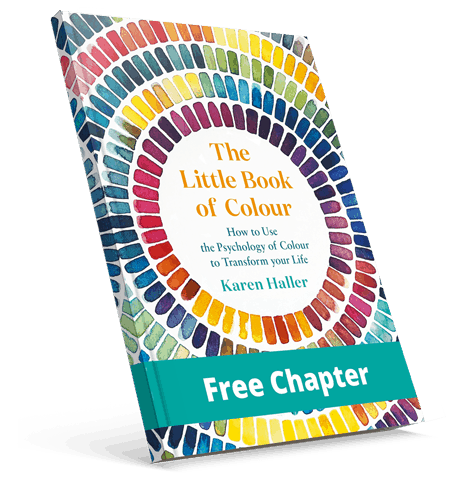
And if you would love some help to reignite your colour confidence, you can download the first chapter of my book – The Little Book of Colour for free.
Wishing you a colourful day,
Karenx
SIGN UP FOR MY NEWSLETTER
Get a Free Chapter from The Little Book of Colour
© Karen Haller
Designed by cptcreative.com